
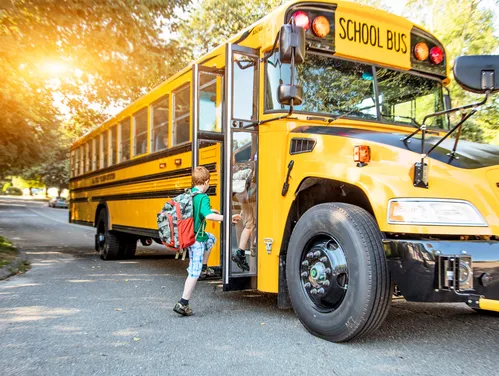
With more than 8,500 school buses and school vehicles on the roads in Iowa communities this year, National School Bus Safety Week is an important reminder that everyone plays a part in keeping students safe on and around school buses.
“Drivers on the road can help student passengers–as well as the bus driver and themselves–stay safe by slowing down, keeping alert and following the rules for school bus stops,” said Tom Simpson, state director for pupil transportation at the Iowa Department of Education. “By using caution while sharing the road, we can provide a safe and efficient transportation system for students across the state.”
This year’s National School Bus Safety Week, themed as “Safe Rides, Everyday Heroes,” spotlights the importance of safe practices around school buses and school bus stops. With over 223,000 Iowa students, from pre-kindergarten to high school ages, depending on school buses for daily transportation, neighborhood bus stop locations can often be busy and crowded with students. Drivers on the road are encouraged to stay attentive in these areas and watch for frequent stops.
“Patience is key when driving near bus stop locations,” Simpson said. “Watch for the bus’s flashing lights and extended stop sign as it may make several stops to pick up or drop off students. Drivers must be ready to adjust their speeds and come to a full stop when a bus extends the stop sign.”
Driving safely and stopping for the bus’s stop sign not only helps keep students safe, it also saves drivers from unnecessary citations and fines.
“School bus stop violations are often recorded by school buses on the road and forwarded to law enforcement officials,” Simpson said. “Drivers can easily avoid hefty fines by practicing safety and being cautious while driving.”
Parents are also encouraged to practice safe bus stop habits with their kids, ensuring they understand when it is safe to approach the bus.
“Students in the process of entering or exiting the bus are more likely to be injured compared to when a student is being transported in a bus, so it is important for students to make sure that school bus drivers and other motorists can see them,” Simpson said. “Students and parents should not stand too close to the bus where the bus driver can’t see them. The driver will signal when students can approach and load onto the bus safely.”
To assist students with learning more about bus safety, schools are required to provide instruction in safe riding practices for students twice per year. The training covers what to do in an emergency and how to evacuate a bus safely.
“We want all students to feel safe while riding the school bus,” Simpson said. “The training helps to ensure that students are aware of safe riding practices and are prepared and know what to do in an emergency.”
Iowa students, themselves, have also assisted in promoting school bus safety this year, by submitting artwork for the 2026 School Bus Safety Week Poster Contest. As part of a national initiative to highlight school bus safety, the poster submissions showcased the impact of school bus safety and a commitment to keeping their peers safe while on the road. Poster winners included Humboldt Community School District’s Eleanor Draeger and Benton Community School District’s Scout Sexton and Lexi Wiley.
“We are thankful for the students, families, bus drivers and other motorists in the community for doing their part to keep kids safe,” Simpson said. “There are a lot of distractions out on the road, at bus stops and at school drop off areas, but with everyone’s help, we can ensure student safety. We can each be an everyday hero for school bus passengers.”
A list of helpful reminders while sharing the road with school buses is provided below.
Reminders for other drivers:
- When the bus’s yellow flashers turn on, that signifies that it is preparing to have a child get on or off the bus. All vehicles behind the bus must slow down and stay behind the bus, and then come to a complete stop when the red flashers turn on.
- Motorists approaching a bus from the opposite direction who see yellow flashers in use on a school bus should reduce the vehicle’s speed to 20 mph and be prepared to stop.
- On a two-lane road, traffic in both directions must come to a full stop when the lights are flashing red.
- On a road with more than three lanes -
- Traffic moving in the opposite direction must slow down and proceed with caution when either red or yellow flashers are activated.
- Traffic moving in the same direction must slow down and stay behind the bus when the yellow flashers are activated, and then stop when the red flashers are activated.
- Vehicles must stop at least 15 feet from the bus and remain stopped until the flashing lights are turned off and the stop arm is retracted.
- Failure to comply can result in expensive fines, license suspension, and even time in jail.
Reminders for students:
- Stop and look both ways before crossing a street.
- Make sure your bus driver can see you when you are crossing in front of the bus. If you can't see the driver, the driver can’t see you.
- Never enter the area behind the bus.
- When getting on or off the bus, never cross the street until the bus driver signals it’s OK to cross.
- If you drop something near the bus, do not pick it up. Instead, tell the bus driver what you dropped, and let the driver determine when it is safe for them or another adult to retrieve the item.