
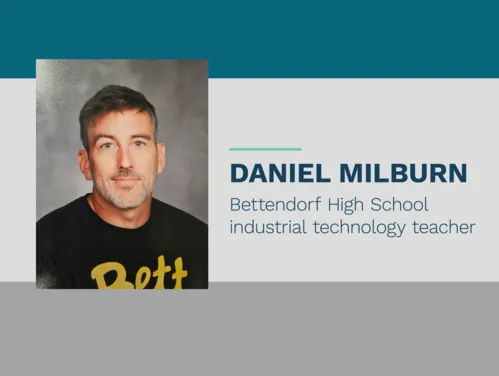
The pathway to teaching career and technical education wasn’t exactly a traditional one for Bettendorf High School industrial technology educator Daniel Milburn. Like many CTE teachers in Iowa, he started off in a different direction, exploring his postsecondary options, working in the industry and gaining valuable real-world experience that still impacts his classroom instruction today.
“After high school, I started out in the military and then went to school to become a firefighter and paramedic,” Milburn said. “I started a tool and die apprenticeship while I was taking courses to become a paramedic, and I eventually realized that I wanted to focus only on toolmaking and got a job at a local shop.”
Coming from a family of toolmakers, Milburn understood the high demand for qualified workers in skilled trades in Iowa and found it to be a good career to pursue. He worked for more than eight years in the tool and die technology industry, building a variety of dies and fixtures and working on installation projects across the country.
“There’s something to be said about working with your hands,” Milburn said. “It’s pretty rewarding to create and build things and take a step back and look at it. There is a lot of satisfaction in that.”
In 2017, Milburn’s career pathway transitioned as he decided to pursue a degree in art education. Inspired by his wife, who also teaches at Bettendorf, and fueled by his strong interest in art, Milburn went back to school at the University of Iowa, earning his bachelor’s degree in 2019. Although he now had a degree in art education, it was his extensive background in skilled trades that connected him to Bettendorf Community School District.
“They were looking for an industrial tech teacher, and I discussed my experience with the associate principal, “Milburn said. “I was able to apply for a CTE authorization from the Board of Educational Examiners to teach CTE. With my work experience, I was authorized to teach machining, welding and drafting. I was also able to get a CWE (Certified Welding Educator) credential through our regional planning partnership to teach concurrent enrollment welding classes.”
The CTE authorization for teacher licensure is an alternative pathway that focuses on individuals who are experts in career and technical positions, such as business, health care, culinary arts and more. The pathway does not require a college degree but instead requires a number of hours in the field that the candidate would be teaching. While completing pedagogy coursework, the educator receives an initial three-year authorization to teach. Afterwards, they can receive a five-year authorization. In 2025-26, 123 new CTE authorizations were issued to Iowa educators.
“Nontraditional pathways to teacher licensure, like the CTE authorization, bring new professionals with valuable experience to our classrooms,” said Mike Cavin, chief of the Bureau of Educational Examiners at the Iowa Department of Education. “The CTE authorization helps to strengthen Iowa’s teacher pipeline and provides students with opportunities to build in-demand technical skills and learn directly from former industry professionals.”
For the past eight years at Bettendorf, Milburn has been teaching a variety of industrial technology classes in welding and machining. His years within the tool and die industry have definitely helped him provide instruction to his students.
“It solidifies what I’m telling them, giving me credibility,” he said. “I have almost 10 years of experience in the industry, which is not the same as learning about it in a college course. I used to build fixtures and can tell kids exactly what goes into that process. There is no comparison.”
Milburn has also had opportunities to incorporate his art degree into his work with students, helping them design and create various projects for the school district and the city of Bettendorf.
“I have blended art with metal working since I got here at Bettendorf,” Milburn said. “Students are able to be creative, doing metal art, using the CNC (Computer Numeric Control) table and creating signs and multi-layer works of art.”
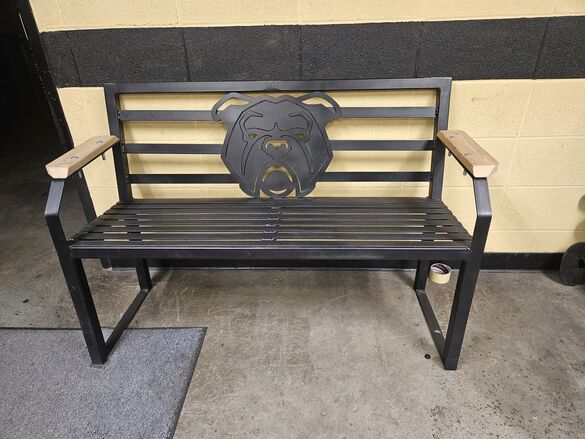
As a result, students have designed, cut and finished appealing, practical-use projects such as benches for campus and yard signs for the local community. The students also partnered with Davenport West High School to build 25 bike racks for the city of Bettendorf. These projects not only provide an opportunity for students to see what they can accomplish with their skills but also help build a sense of belonging in their school and city community.
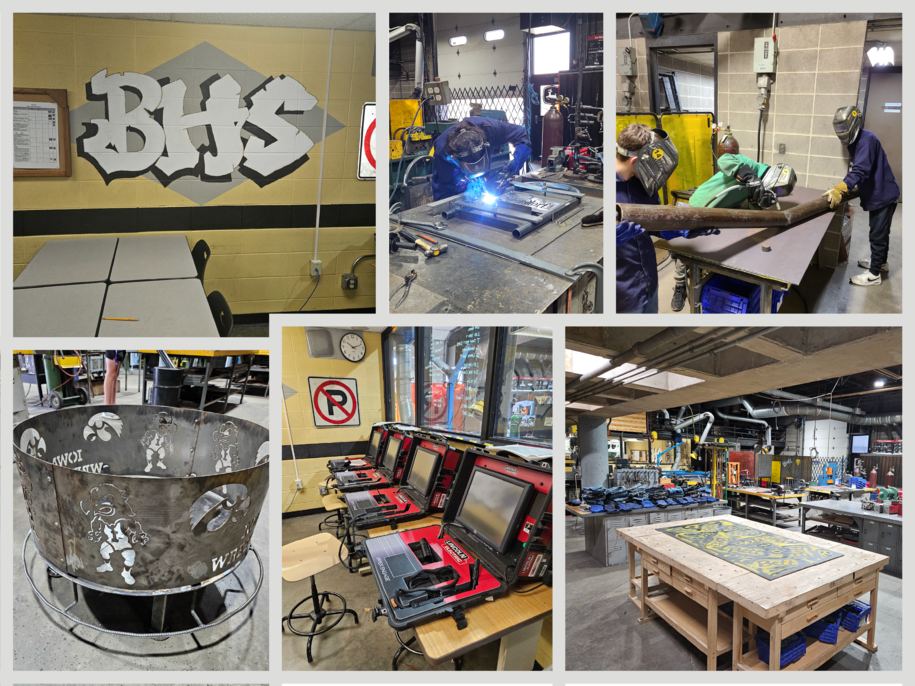
Strong CTE programs like Bettendorf’s help prepare students for employment in current and emerging occupations. Through CTE programs, students often participate in hands-on learning opportunities, make connections to local employers and gain valuable skills and industry-recognized credentials that can be applied to future careers. Teachers with experience in the industry provide yet another benefit for students in CTE programs.
“Having a teacher who has real-world ties and experience to business and industry is a bonus for any Iowa CTE classroom,” said Cale Hutchings, chief for the Department’s Bureau of CTE and Postsecondary Readiness. “High-quality CTE programs led by experienced professionals can help students explore pathways that lead to high-demand, high-skill and high-wage occupations and propel them to a lifetime of career success.”
Milburn has noted that he is continuing to explore how Bettendorf can further strengthen its industrial technology program, focusing on increased career-connected and work-based learning opportunities such as internships and apprenticeships and higher participation in career and technical student organizations like SkillsUSA. With additional growth, Bettendorf ensures that the industrial technology program will continue moving forward, providing optimal experiences for students.
“We have come a long way since I took over for a teacher who retired,” Milburn said. “We’ve made it more industry-friendly and training-friendly, making it a clean place to learn. I’ve enjoyed seeing students buy-in into the program and having positive reactions to how we’ve grown and improved. We want to make this an impactful experience where kids are gaining the skills needed to pursue occupations in their area.”
For Milburn, his journey to becoming a CTE teacher has definitely been rewarding, and his experience has positively influenced many students in their college and career pathways. He encourages other professionals in the industry who are looking to make an impact to consider teaching.
“I know that it can be hard to leave the industry for a variety of reasons,” he said. “It’s a life change, but you can also change lives, even if you don’t realize your impact at first. That lightbulb moment when you see a kid get inspired is an amazing thing.”
To learn more about Iowa’s multiple pathways to licensure, view the Department’s recent story, “ Iowa supports teacher pipeline through nontraditional pathways to licensure.”