
Updated Sept. 4, 2026
Half of all school districts reported no vacancies for the 2025-26 school year
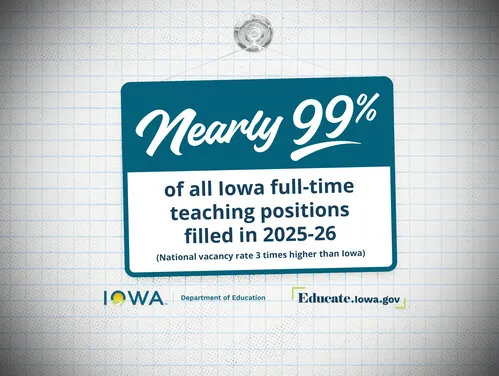
The Iowa Department of Education today released the latest data on teaching vacancies across the state for the 2025-26 school year, highlighting the strength and expertise of Iowa’s teacher workforce. Iowa’s number of unfilled teaching positions represents only 1.15% of all full-time teachers in the 2025-26 school year, compared to 3% nationally of all public school teaching positions vacant during the 2023-24 and 2024-25 school years, according to the National Center for Education Statistics.
“Ensuring every child experiences a world-class education is only made possible by having a great teacher with every student in every classroom,” said Iowa Department of Education Director McKenzie Snow. “That’s why Iowa has made strengthening our teacher pipeline and supporting dedicated educators in doing their best work a top priority. Forging multiple pathways to the profession, spearheading historic teacher pay raises, celebrating educators who accelerate student learning, and aligning teacher preparation and professional learning to what we know works for children all demonstrate the national leadership of Iowa and our talented educators.”
Each year, Iowa school districts are required by law to report the number of full-time teaching positions that were advertised but not filled or that were filled with temporary/substitute staff. All 325 Iowa public school districts complied with this requirement for the 2025-26 school year. In addition to national vacancy rates being nearly three times higher than Iowa’s vacancy rates, the latest statewide numbers show a substantial 34% decrease in overall vacancies reported by Iowa school districts from last school year. For the 2025-26 school year, the total number of unfilled full-time equivalent (FTE) teaching positions reported was 434, representing only 1.15% of all full-time teachers—the lowest number reported since this data collection started four years ago. Half of all Iowa public school districts reported no teaching vacancies this year. Prior years’ vacancies represented:
- 1.75% of all full-time teachers (661 FTE) in 2024-25,
- 2.03% (763 FTE) in 2023-24 and
- 2.63% (941 FTE) in 2022-23.
Consistent with national teacher pipeline needs, special education positions continue to have the highest number of vacancies, at 184. Music education with a music endorsement came in next with 35 vacancies. Mathematics and science positions followed at 28 vacancies each.
“Building upon our collective work to strengthen Iowa’s teacher pipeline, we will continue partnering with educators, schools and districts, teacher preparation programs, and communities to deepen support for those endorsement areas and geographies most in need of great teachers,” said Iowa Department of Education Director McKenzie Snow.
This crucial data is also used to identify teacher shortage designation areas with the U.S. Department of Education. States can report critical teacher shortage areas of up to 5% of their full-time equivalent positions. Iowa’s total teacher shortage areas have been well under the 5% federal threshold, meaning Iowa has been able to include every teaching area with at least one vacancy as a teacher shortage area. This year, Iowa was able to include 26 potential teacher shortage areas across various classroom subjects.
“By reporting all possible teacher shortage area designation, teachers serving in these identified areas may become eligible for student loan repayment, forgiveness and other incentives available through state and federal programs,” said Jay Pennington, division administrator of teacher quality and innovation at the Iowa Department of Education. “Since Iowa’s teacher shortage is well below the federal 5% threshold, we are able to report all vacancies as teacher shortage areas, even if there was only one vacancy, further supporting our strong teacher pipeline and workforce.”
Iowa’s success in filling positions has been supported by several initiatives and teacher pathways that invest in growing the teaching profession. Starting in 2024, both new and experienced teachers received historic pay raises, with Iowa investing $96 million in teacher salaries. Additionally, a total of $8.5 million through the Teachers Accelerating Learning Incentive Fund celebrated outstanding teachers with supplementary pay of up to $2,500 per year.
Iowa is committed and intentional in navigating additional opportunities to increase pathways for teacher licensure, supporting districts with tools and resources for recruitment and retention, while ensuring quality of the teacher preparation. Governor Kim Reynolds’ $49 million Teacher and Paraeducator Registered Apprenticeship (TPRA) program partners with 134 school districts to support 1,081 registered apprentices attain an associate degree and become a certified paraeducator or a bachelor’s degree to become a licensed teacher. Other flexible teacher pathways include the Teacher Intern Program, Content Area Specialist Authorization, Native Language Teacher Authorization and Career and Technical Authorization. All four of these pathways maximize an individual’s experience in the field, maintain high standards for licensure, but do not require completion of a traditional four-year teaching degree.
More information on teacher vacancies by school district and the full list of designated shortage areas can be found on the Department’s website.